Branch: 1000 Parkinson Road, Woodstock
0 CAD 0.00
items in your cartto quote To cart
Ooops no items were found.
Try something else.
Ok
Loading…

Energy Saving Benefits of Sealing the Building Envelope

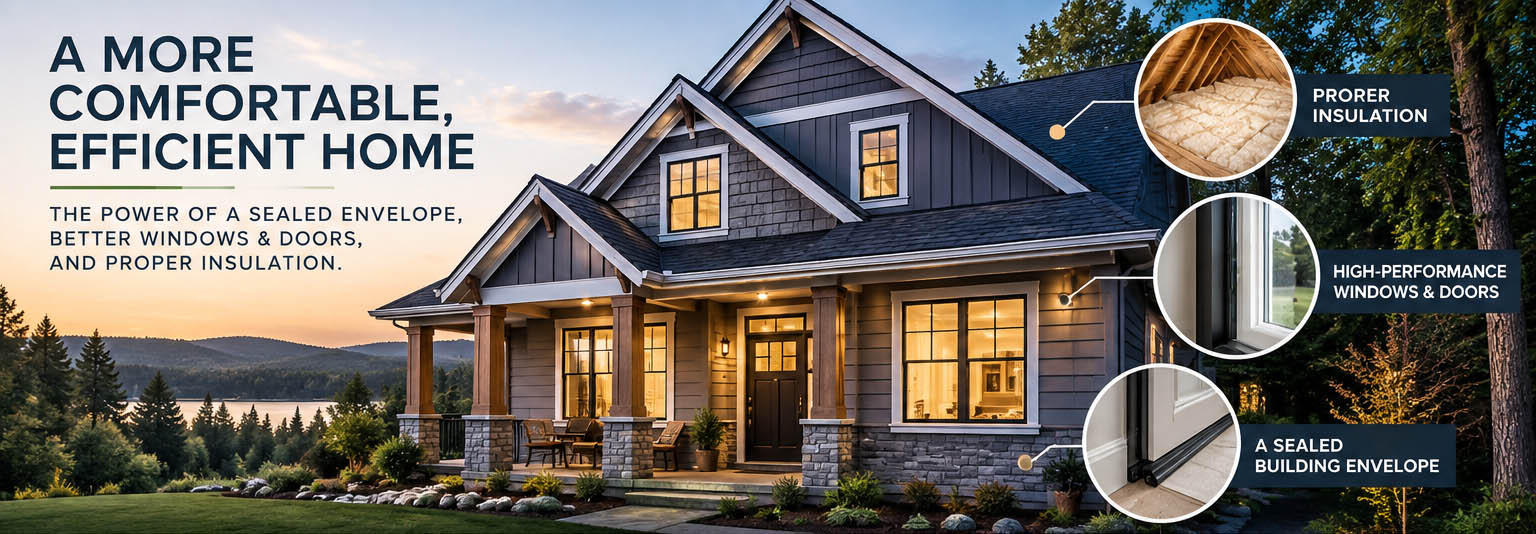
House showing proper insulation, high performance windows & doors and a sealed building envelope House showing proper insulation, high performance windows & doors and a sealed building envelope

Written by Adams Building Supply

Better Windows, Doors and Insulation Can Make a Home More Comfortable, Efficient and Durable


The House as a System

When homeowners think about energy efficiency, the conversation often starts with the furnace, air conditioner or thermostat. Those systems matter, but some of the most effective energy improvements happen before heated or cooled air ever reaches a room. The real starting point is the building envelope: the connected system of walls, roof or attic, foundation, windows, doors, insulation, air barriers and weather-sealing that separates the conditioned interior of a home from the outdoors.

A well-performing envelope helps keep winter heat inside, summer heat outside and unwanted air and moisture movement under control. In Southern Ontario’s climate, where homes experience cold winters, humid summers and significant seasonal temperature swings, that control can have a meaningful effect on comfort, energy use and the long-term performance of the building.

The important word is system. Adding insulation while ignoring major air leaks, or replacing a window without properly sealing the opening around it, can leave much of the potential benefit unrealized. The strongest results come from looking at the home as a whole and improving the weakest parts of the envelope in a logical order.


Start by Controlling Air Leakage

Uncontrolled air leakage is one of the most common sources of energy loss in existing homes. Gaps around windows and doors, attic penetrations, plumbing and electrical openings, rim joists, exhaust vents and transitions between building materials can allow conditioned air to escape while outdoor air finds its way in.

Air sealing is therefore an important first step in many energy-upgrade projects. Depending on the location, that can involve high-quality caulking, low-expansion window and door foam, weatherstripping, gaskets, tapes, membranes and other compatible air-sealing products. The goal is not simply to make a house “tight.” It is to create a controlled enclosure so that ventilation occurs intentionally rather than through random cracks and gaps.

A tighter envelope can reduce drafts and temperature swings and can help heating and cooling equipment maintain the desired indoor temperature with less cycling. In older homes especially, careful sealing of accessible leakage points can make rooms feel noticeably more comfortable even before larger upgrades are completed.


Upgrade Windows and Doors for More Than Appearance

Windows and exterior doors are highly visible components of the envelope and often become obvious weak points as they age. Failed seals, deteriorated weatherstripping, poorly fitted frames, older glazing and installation gaps can contribute to drafts, cold interior surfaces, condensation and unwanted solar heat gain.

Modern high-performance windows can incorporate multiple panes of glass, insulating gas fills, low-emissivity coatings, improved frame materials and warm-edge spacer technology. Exterior doors can offer insulated cores, improved thresholds and more effective perimeter seals. The exact product should be selected for the opening, exposure, orientation and performance requirements of the home rather than appearance alone.

Installation quality is just as important as the product itself. A premium window placed into an opening that is not properly flashed, insulated and air-sealed may underperform and can create moisture-management problems. Good installation integrates the window or door into the drainage plane, air barrier and insulation system of the wall.

There is also a lifestyle benefit. Better-performing windows and doors can reduce cold drafts near seating areas, make rooms beside large glass surfaces more usable in winter, reduce exterior noise and refresh the look of a home. Energy efficiency and comfort are closely connected.


Insulation: Put the Right Material in the Right Place

Insulation slows heat flow through the building enclosure. In practical terms, it helps keep heat where homeowners want it: inside during winter and outside during summer. But insulation works best when it is continuous, correctly installed and paired with effective air and moisture control.

Attics are often a priority because warm air rises and because many older homes have insufficient, compressed or uneven insulation. Walls, basements, crawlspaces and rim joists can also present opportunities, particularly during renovations when assemblies are already open.

Different applications may call for different products, including batt, blown-in, rigid board, mineral wool or spray-applied systems. There is no single insulation product that is ideal for every location. The assembly, moisture conditions, fire requirements, available space, local code requirements and renovation scope all matter.

More insulation is not automatically better if it is installed poorly. Gaps, compression, missing sections and thermal bridges can reduce performance. Proper detailing around penetrations, framing transitions and difficult-to-reach areas is essential to achieving the intended result.


Comfort, Moisture Control and Durability

Energy savings are only part of the value of envelope improvements. A better enclosure can improve surface temperatures and reduce the cold spots that make a room feel uncomfortable even when the thermostat says the temperature is correct. It can also help manage condensation risk by reducing uncontrolled movement of warm, moisture-laden indoor air into cold building assemblies.

Moisture deserves particular attention. Homes need to manage rainwater, groundwater, water vapour and indoor humidity. Air barriers, vapour-control layers, flashing and drainage details each perform different jobs. Renovations should respect how the existing home was built and how new materials will interact with the old assembly.

As homes become tighter, intentional ventilation becomes increasingly important. Kitchen and bathroom exhaust, make-up air where required and properly designed mechanical ventilation help maintain indoor air quality. Energy efficiency should never mean simply sealing every opening without considering ventilation, combustion safety and moisture.


Plan the Upgrade as a Sequence

For homeowners considering several improvements, a practical sequence begins with understanding current conditions. An energy assessment or experienced building professional can help identify air leakage, insulation deficiencies and other priorities. From there, projects can be coordinated so that one improvement does not have to be undone to complete another.

For example, if siding is being replaced, it may be the ideal time to consider exterior insulation and improved air- and water-control layers. If a kitchen renovation requires opening exterior walls, insulation and air sealing can be addressed before the finishes go back on. If windows are due for replacement, the rough openings can be detailed correctly at the same time.

This coordinated approach can reduce duplicated labour, protect the investment and improve overall performance.


Build Better Comfort Into the Home

The best energy-saving renovation is not always the most glamorous one, but homeowners feel its benefits every day. A well-sealed, properly insulated envelope with quality windows and doors can create more even temperatures, fewer drafts, better comfort and a home that is easier to heat and cool.

At Adams Building Supply, we believe the right project begins with the right materials, good planning and practical advice. Whether the next step is weather-sealing a troublesome door, improving attic insulation, replacing windows or planning a larger renovation, our team can help homeowners and contractors identify products that work together as part of a complete building system.

Before beginning significant envelope work, confirm applicable building-code requirements and consider qualified professional guidance where structural, moisture, ventilation or combustion-safety issues are involved. Done properly, envelope improvements are an investment not only in energy efficiency, but in comfort, durability and the everyday quality of the home.


PROJECT NOTE Product availability, installation requirements and building-code considerations vary by project. Consult qualified professionals where appropriate.

SEARCH ×

Search